
Volunteers from different religious and cultural communities removed 50 kilograms of waste near Padua’s railway station, continuing a series of joint initiatives promoting environmental responsibility and community cooperation.
Brussels, Brussels, Belgium, 8th Oct 2026 — Scientology Volunteer Ministers joined members of Padua’s Muslim, Bangladeshi and Pakistani communities on Sunday, 4 October, for a neighbourhood cleanup in Borgomagno, near the city’s railway station. The volunteers collected approximately 50 kilograms of discarded materials from an area affected by recurring illegal waste disposal, combining practical environmental action with cooperation across different religious and cultural backgrounds.
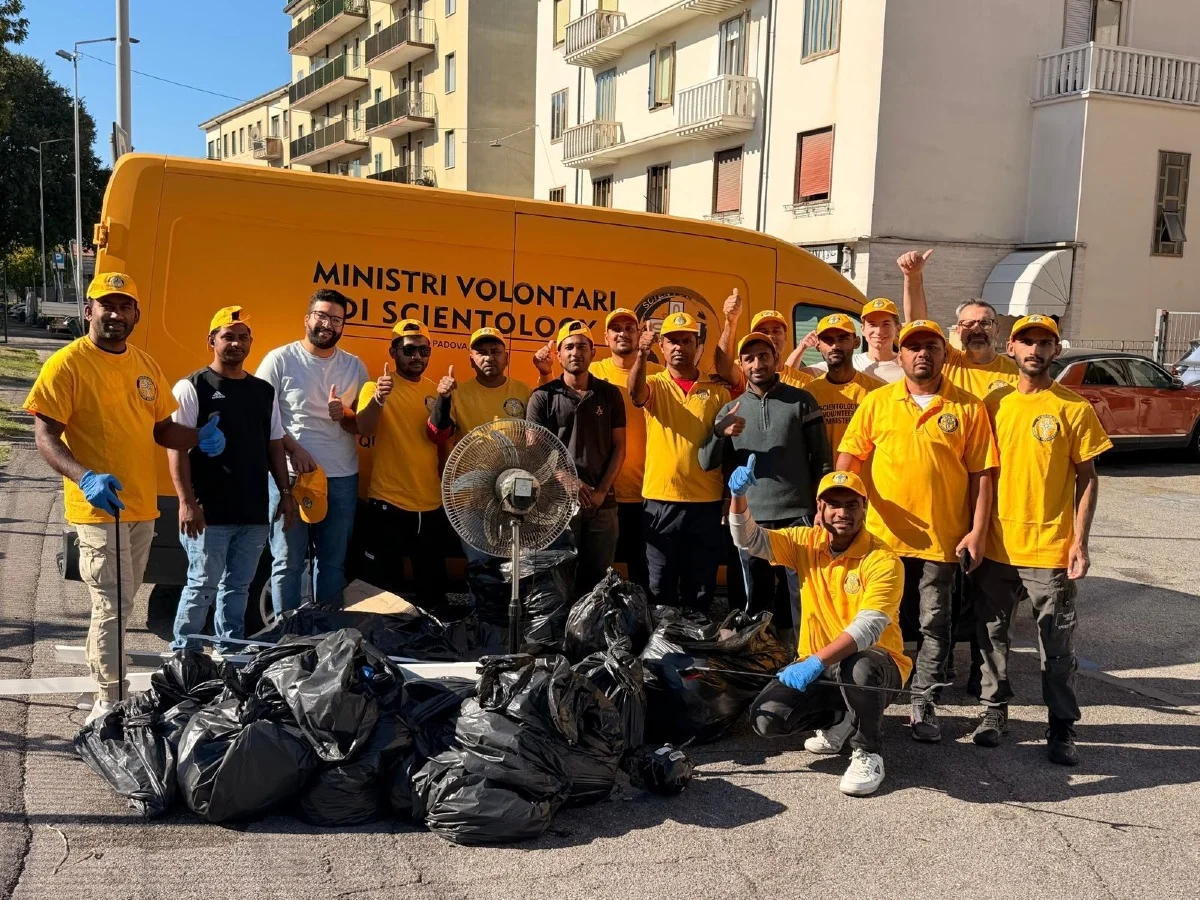
The initiative took place around the railway overpass, an area used by residents and people travelling through the neighbourhood. Volunteers removed discarded glass, plastic packaging, damaged household materials, clothing and other accumulated waste, helping restore the condition of a public space regularly affected by littering.
The activity brought together Scientology Volunteer Ministers from Padua and volunteers associated with the city’s Muslim, Bangladeshi and Pakistani communities. The participants worked towards a shared objective: improving the surroundings for everyone who lives in or passes through the area.
The cleanup also attracted the attention of residents and passers-by, some of whom expressed their appreciation to the volunteers during the morning. Beyond collecting waste, the participants sought to draw attention to the importance of looking after shared urban spaces and the contribution that individual residents and community organisations can make to their neighbourhoods.
A Continuing Partnership Across Communities
The Borgomagno initiative forms part of a broader pattern of joint environmental activities in Padua, where Scientology Volunteer Ministers have been working alongside volunteers from Muslim and South Asian communities.
On 13 September, 18 volunteers participated in a cleanup around Via Rubaltelli and Via Jacopo D’Avanzo, collecting more than 50 kilograms of abandoned waste near a frequently used shopping and pedestrian area.
A further initiative took place on 20 September in the Stanga neighbourhood, where Scientology volunteers and members of local Muslim and Bangladeshi communities worked along Via Venezia and surrounding streets, including Via Pietro Donà, Via della Croce Rossa and Via Gauslino Transalgardo.
The October activity also marked a return to Borgomagno, where a similar collaborative cleanup had taken place on 31 May. That earlier operation, likewise involving Scientology Volunteer Ministers and members of the local Muslim community, removed approximately 50 kilograms of discarded materials from the vicinity of the railway overpass.
Taken together, these activities demonstrate a continuing relationship between volunteers who may come from different religious traditions and cultural backgrounds but share an interest in their city’s public spaces.
They also illustrate how community cooperation can develop through relatively straightforward activities. Rather than requiring agreement on religious or philosophical questions, the participants identify a common local concern and work together to address it.
Environmental Responsibility and Everyday Coexistence
Padua, a university city in Italy’s Veneto region, has a long history of cultural exchange and a population encompassing people from different nationalities, religions and traditions.
As in other European cities, public spaces provide opportunities for people from diverse backgrounds to interact. Their maintenance is also an everyday concern, particularly in areas affected by persistent littering or illegal dumping.
Local cleanup initiatives offer one way for community organisations and residents to participate directly in improving these shared surroundings. By working alongside one another, volunteers can also establish relationships that extend beyond the immediate activity.
In Padua, the participation of Scientology volunteers together with Muslim, Bangladeshi and Pakistani community members gives this practical work an additional dimension. Their collaboration demonstrates that religious and cultural differences need not prevent individuals from accepting common responsibilities towards the wider community.
The successive cleanups also highlight the value of sustained civic participation. Recurring waste disposal requires continuing attention, and locally organised activities can contribute both to the physical condition of public spaces and to public awareness of the issue.
Scientology Volunteer Ministers and Community Service
The activities are connected to the international Scientology Volunteer Ministers programme, established by Scientology founder L. Ron Hubbard in the mid-1970s and supported by the Church of Scientology as a religious social service.
The programme was developed around the principle that individuals can take practical steps to help others and improve conditions in their communities. Its activities range from assistance following natural disasters and emergencies to educational programmes, community support and neighbourhood initiatives.
Volunteer Ministers operate under the motto “Something Can Be Done About It“, reflecting the programme’s emphasis on personal initiative and practical help. The programme also provides training resources for people who wish to assist others, irrespective of their religious background.
In Italy, Scientology volunteers have participated in environmental activities, educational initiatives, drug-prevention campaigns and other forms of community service. The Padua collaborations demonstrate how this approach can be developed with people and organisations outside the Church itself.
Ivan Arjona, representative of the Church of Scientology to the European Union, OSCE, Council of Europe and United Nations, linked the Padua activities to broader European principles of coexistence and civic responsibility:
“Europe’s diversity is one of its greatest social realities, and its strength depends on how people live and work together despite their differences. In Padua, Scientology volunteers and their Muslim neighbours, alongside people from Bangladeshi and Pakistani communities, are demonstrating something important: respect for different beliefs becomes especially meaningful when it is accompanied by cooperation. Protecting our shared environment, respecting one another’s dignity and taking responsibility for the places where we live are all expressions of the same commitment to a society in which everyone belongs.”
The cooperation observed in Padua reflects a wider European understanding of civic participation, in which religious organisations, cultural associations and individual citizens contribute to community life while retaining their respective identities.
Religious freedom and non-discrimination are fundamental principles of Europe’s human-rights framework. Practical initiatives involving participants from different faiths and communities offer opportunities to give these principles an everyday expression through shared responsibilities and mutual respect.
For the volunteers in Borgomagno, those principles took a practical form: working together to remove accumulated waste from a public area and improve conditions for the people who use it.
The October cleanup therefore represents both a local environmental contribution and another example of cooperation between different communities in Padua, where shared civic objectives continue to provide common ground for voluntary action.
About the Church of Scientology
The Church of Scientology, its churches, missions, groups and members are present throughout the European continent. According to its European Office, Scientology maintains more than 140 churches, missions and affiliated groups across at least 27 European countries, alongside community initiatives focusing on education, drug prevention, human rights and neighbourhood improvement, inspired by the work of Scientology founder L. Ron Hubbard. Within Europe’s diverse national legal frameworks, recognition of Scientology as a bona fide religion and, in applicable jurisdictions, as a charitable religious organisation has developed through administrative and judicial decisions. The Church continues to support programmes aimed at education, prevention, volunteer service and community betterment.
Media Contact
Organization: European Office Church of Scientology for Public Affairs and Human Rights
Contact Person: Ivan Arjona
Website: https://www.scientologyeurope.org
Email: Send Email
Address: Boulevard de Waterloo 103
City: Brussels
State: Brussels
Country: Belgium
Release id: 49777
The post Scientology and Muslim Volunteers Unite for Cleaner Neighbourhoods in Padua appeared first on King Newswire. This content is provided by a third-party source.. King Newswire makes no warranties or representations in connection with it. King Newswire is a press release distribution agency and does not endorse or verify the claims made in this release. If you have any complaints or copyright concerns related to this article, please contact the company listed in the ‘Media Contact’ section

Disclaimer: The views, suggestions, and opinions expressed here are the sole responsibility of the experts. No The Insure Life journalist was involved in the writing and production of this article.